
Post 01 · Strategy
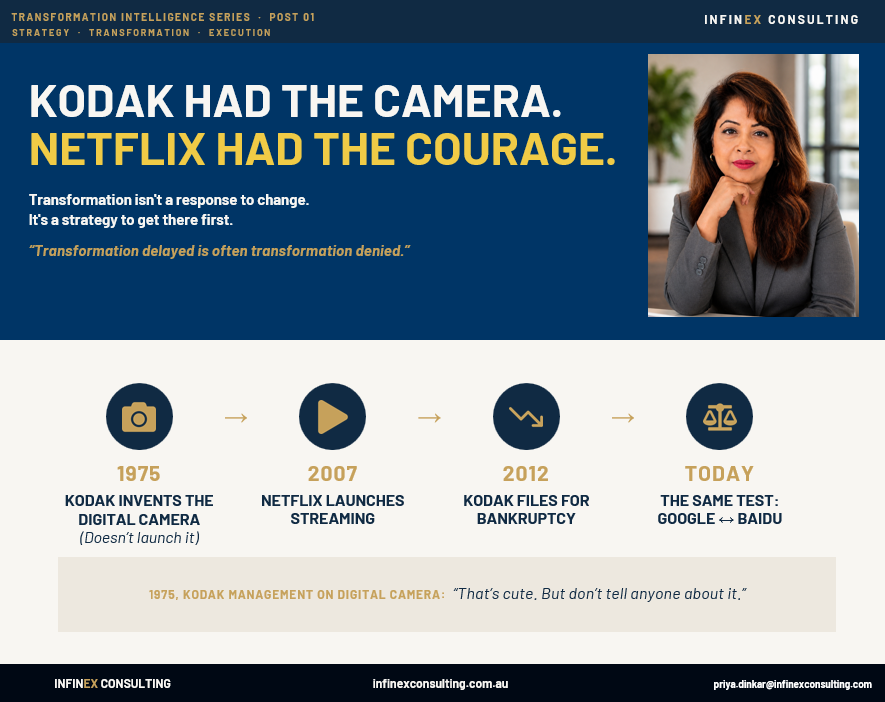
Kodak Had the Camera.
Netflix Had the Courage.
Transformation isn't a response to change. It's a strategy to get there first.
Priya Dinkar · Founder & Principal, Infinex Consulting · 1 min read
───────────────────────────────
Here’s a question for every leadership team:
Would you cannibalise your own business before someone else does it for you?
That's the uncomfortable test.
Netflix passed it.
In 2007, its DVD-by-mail business was still growing. Nobody was forcing a change.
Netflix chose to launch streaming anyway, knowingly cannibalising the business that had made it successful.
That took courage.
At the time, Netflix generated just over US$1.2 billion in annual revenue.
Today, it generates more than US$45.2 billion, serving over 325 million paid memberships worldwide.
Sometimes, the biggest growth comes from having the courage to cannibalise your own success.
Kodak faced the same test.
In 1975, engineer Steven Sasson built the first digital camera inside Kodak's own labs.
Management's response, by his own account:
"That's cute. But don't tell anyone about it."
Protecting the profitable film business felt safer than cannibalising it.
When Kodak finally embraced digital, the market had already moved on.
Kodak filed for bankruptcy in 2012.
Transformation delayed is often transformation denied.
We're watching the same leadership test play out again, this time with AI.
Google chose to embed AI directly into Search and Cloud while both businesses were still growing. In Q4 2025, Search revenue grew 17% year on year and Cloud grew 48%, showing AI strengthening the core business rather than replacing it.
Baidu, often described as "China's Google", illustrates the harder path. In Q3 2025, its online marketing business declined 18% year on year - a figure that already includes AI-native tools built into that same product, up 262%. The rest of that same online marketing business hasn't made the shift.
Its separate AI Cloud arm grew 21%, but that's adjacent revenue, not the core changing.
Growing AI beside the core isn't the same as growing AI inside it.
Different companies. Different decades. Different technologies.
The same leadership choice.
Transformation doesn't fail because organisations can't see the future.
It fails because they're unwilling to challenge a successful present.